
kilkenny Arts Festival
2024
ANIMATION
PROJECTION MAPPING
2024
Six Sides Sawn
ANIMATION
PROJECTION MAPPING
Having had a blast making Light Up The Castle for Kilkenny Arts Festival in 2023, I was absolutely thrilled when Olga and Marjie asked if I’d like to come back to work on 2024’s edition. This is the definition of a no-brainer.
Some time after the 2023 festival, I had an idea that involved making it appear that Kilkenny Castle is being re-built using a jigsaw. That’s what I ended up doing, plus two other full sequences.
The Irish Times wrote a lovely preview of it in The Ticket
![]()
![]()
Here is a low quality (my fault) recording of one of the performances. A low quality live recording is still better than sharing the original material, because at least it gives a sense of scale - Kilkenny Castle’s Rose garden facade is over 50m wide, so definitely the largest image I’ve projected to date. Also, camera’s are still not as good as our eyeballs at capturing something like this, but anyway, herewith
Making It
The idea was to ‘rebuild’ the Kilkenny Castle out of jigsaw pieces, and then animate those pieces to tell a grand story using medieval illustrations. To do this, we needed to make the jigsaw using a carefully calibrated and tone graded image, that lined up perfectly with the physical castle when projected.
An additional challenge was to make the jigsaw pieces fit tightly enough to minimise gaps, but not so tight as for it to be difficult to assemble on camera.
This took quite a bit of experimenting and testing. First challenge was that the size I settled on required printing the image in three sections - getting these three images to print with near-identical tone was surprisingly difficult. Next was adhering the image to the 4mm board so that it absolutely wouldn’t peel during multiple assembly attempts. Protecting the print from the laser cutter was also big challenge - we ended up using a combination of a matte glaze and multipass cutting with a lower power laser setting.
![]() Above: mismatched prints, eventually fixed. You can see how tightly fitting the pieces are.
Above: mismatched prints, eventually fixed. You can see how tightly fitting the pieces are.
Animating the jigsaw
The initial assembly of the jigsaw you see in the video, is done almost entirely with my hands. Erin helps to place a couple of pieces in my hands in a couple of places. To make this work, I carefully mapped out an assembly sequence, so that later, I could composite shots in such a way that it seemed like lots was happening in parallel. This meant that all the moves needed to be carefully planned to not intersect. This turned out to be a huge editing compositing task that required lots of subtle retiming and garbage matting to make it all work. In a few places there are ugly jigsaw wobbles if you don’t look at the hands - but it’s not bad!
![]() The bling of my court jester slash medieval magician type character.
The bling of my court jester slash medieval magician type character.
As is often the case with these weird projects, I needed to come up with some creative technical solutions for how to actually film the thing. To avoid having a printed template under the jigsaw (as a reference for me to line up the pieces) I instead made a transparent guide image with numbered pieces, and used Dragonframe stop motion software to overlay that on the live image from the camera. This way, I could watch a monitor and place pieces in exactly the right place. Each physical piece had a number written on the back, so I just needed to follow the script. It took a lot of practice and many takes!
Screen-printing and Black 2.0
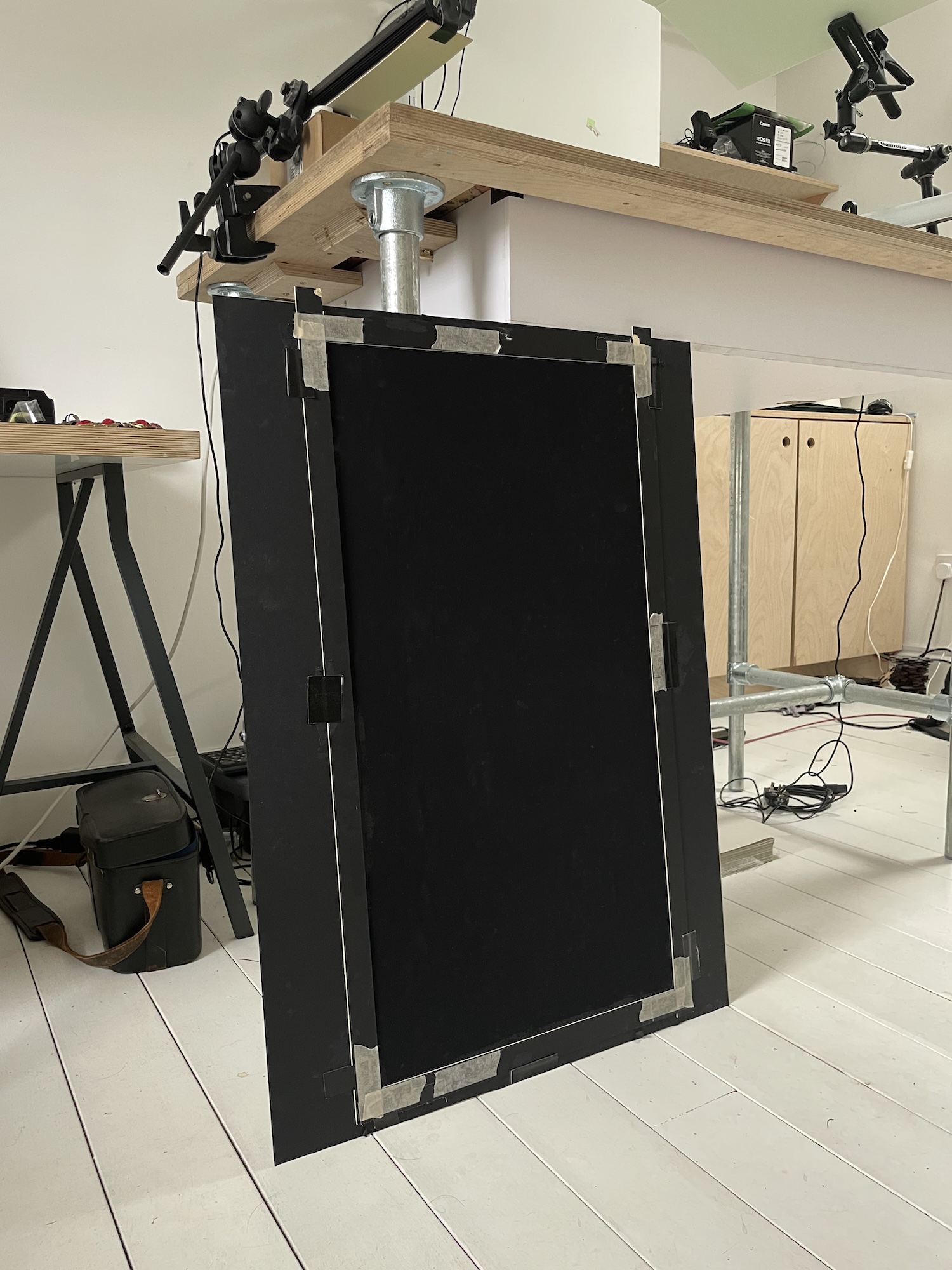
“Why, pray tell” I hear you cry, did you need screen-printing in all this? It turned out to be the ideal way to create A1-sized template of the castle outline, which I had also used for 2023’s project. Screen-printing through an extra-fine screen let me print black on matte black - so the printed lines didn’t show up in the footage, and green-on-green so both background and guidelines keyed out. Finally, for the jigsaw, the matte black card stock I was using for the background wasn’t black enough - and was reflecting some light from my lighting setup. Black 2.0 to the rescue - check out the image below - Black 2.0 (centre rectangular area) with the unpainted ‘black’ card stock visible in the perimeter.
![]()
![]()
Some time after the 2023 festival, I had an idea that involved making it appear that Kilkenny Castle is being re-built using a jigsaw. That’s what I ended up doing, plus two other full sequences.
The Irish Times wrote a lovely preview of it in The Ticket
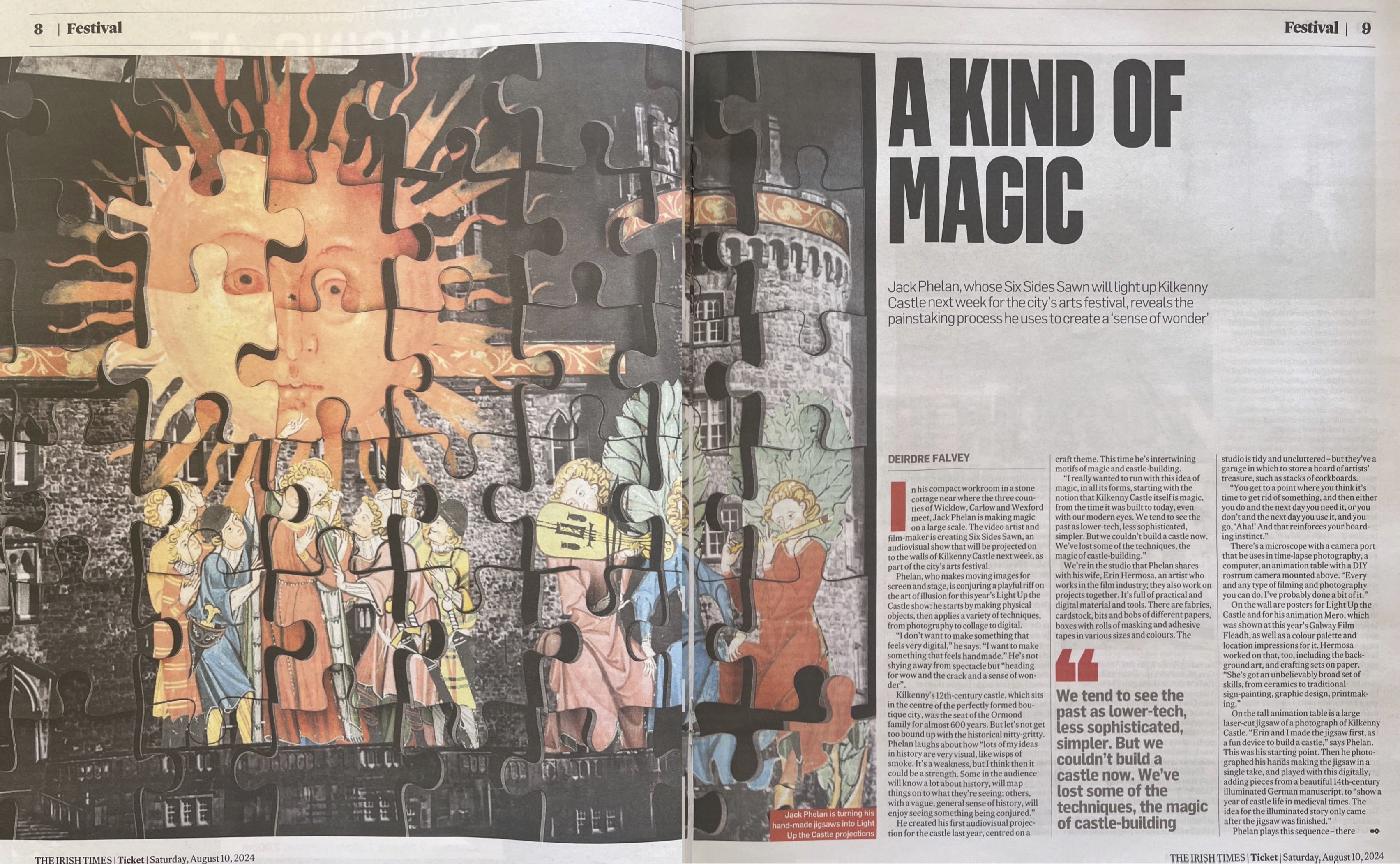
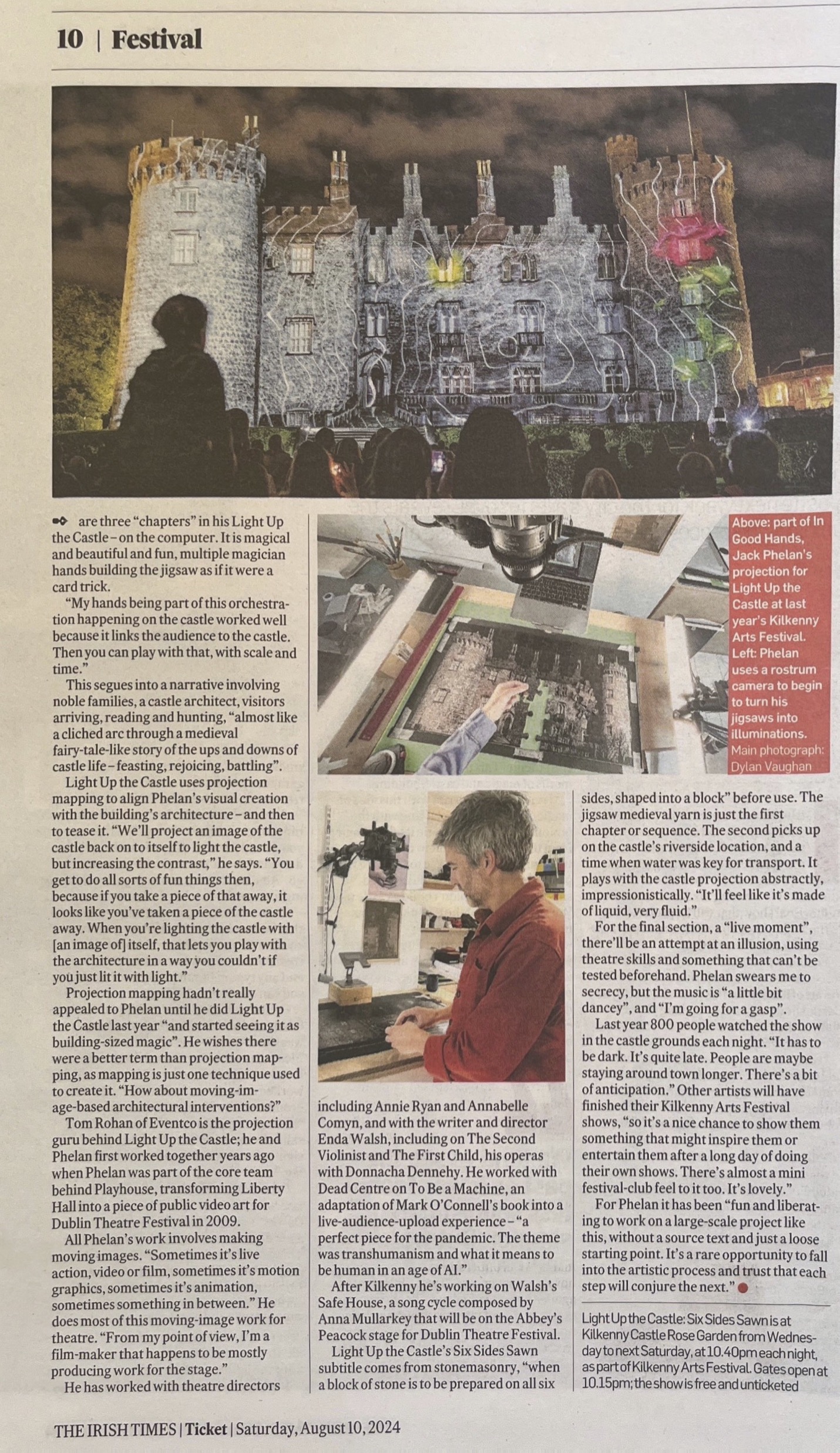
Here is a low quality (my fault) recording of one of the performances. A low quality live recording is still better than sharing the original material, because at least it gives a sense of scale - Kilkenny Castle’s Rose garden facade is over 50m wide, so definitely the largest image I’ve projected to date. Also, camera’s are still not as good as our eyeballs at capturing something like this, but anyway, herewith
Making It
The idea was to ‘rebuild’ the Kilkenny Castle out of jigsaw pieces, and then animate those pieces to tell a grand story using medieval illustrations. To do this, we needed to make the jigsaw using a carefully calibrated and tone graded image, that lined up perfectly with the physical castle when projected.
An additional challenge was to make the jigsaw pieces fit tightly enough to minimise gaps, but not so tight as for it to be difficult to assemble on camera.
This took quite a bit of experimenting and testing. First challenge was that the size I settled on required printing the image in three sections - getting these three images to print with near-identical tone was surprisingly difficult. Next was adhering the image to the 4mm board so that it absolutely wouldn’t peel during multiple assembly attempts. Protecting the print from the laser cutter was also big challenge - we ended up using a combination of a matte glaze and multipass cutting with a lower power laser setting.
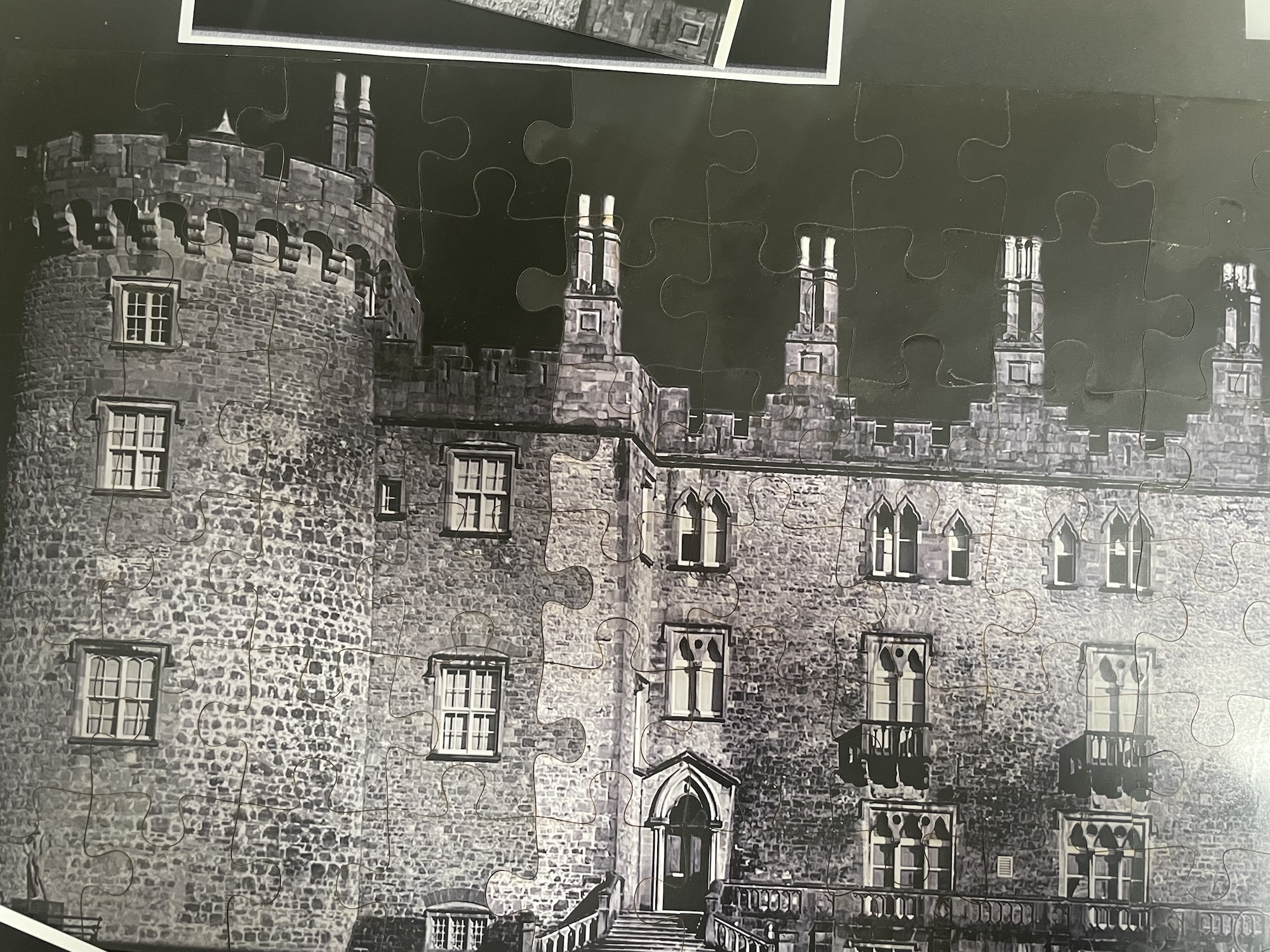 Above: mismatched prints, eventually fixed. You can see how tightly fitting the pieces are.
Animating the jigsaw
The initial assembly of the jigsaw you see in the video, is done almost entirely with my hands. Erin helps to place a couple of pieces in my hands in a couple of places. To make this work, I carefully mapped out an assembly sequence, so that later, I could composite shots in such a way that it seemed like lots was happening in parallel. This meant that all the moves needed to be carefully planned to not intersect. This turned out to be a huge editing compositing task that required lots of subtle retiming and garbage matting to make it all work. In a few places there are ugly jigsaw wobbles if you don’t look at the hands - but it’s not bad!
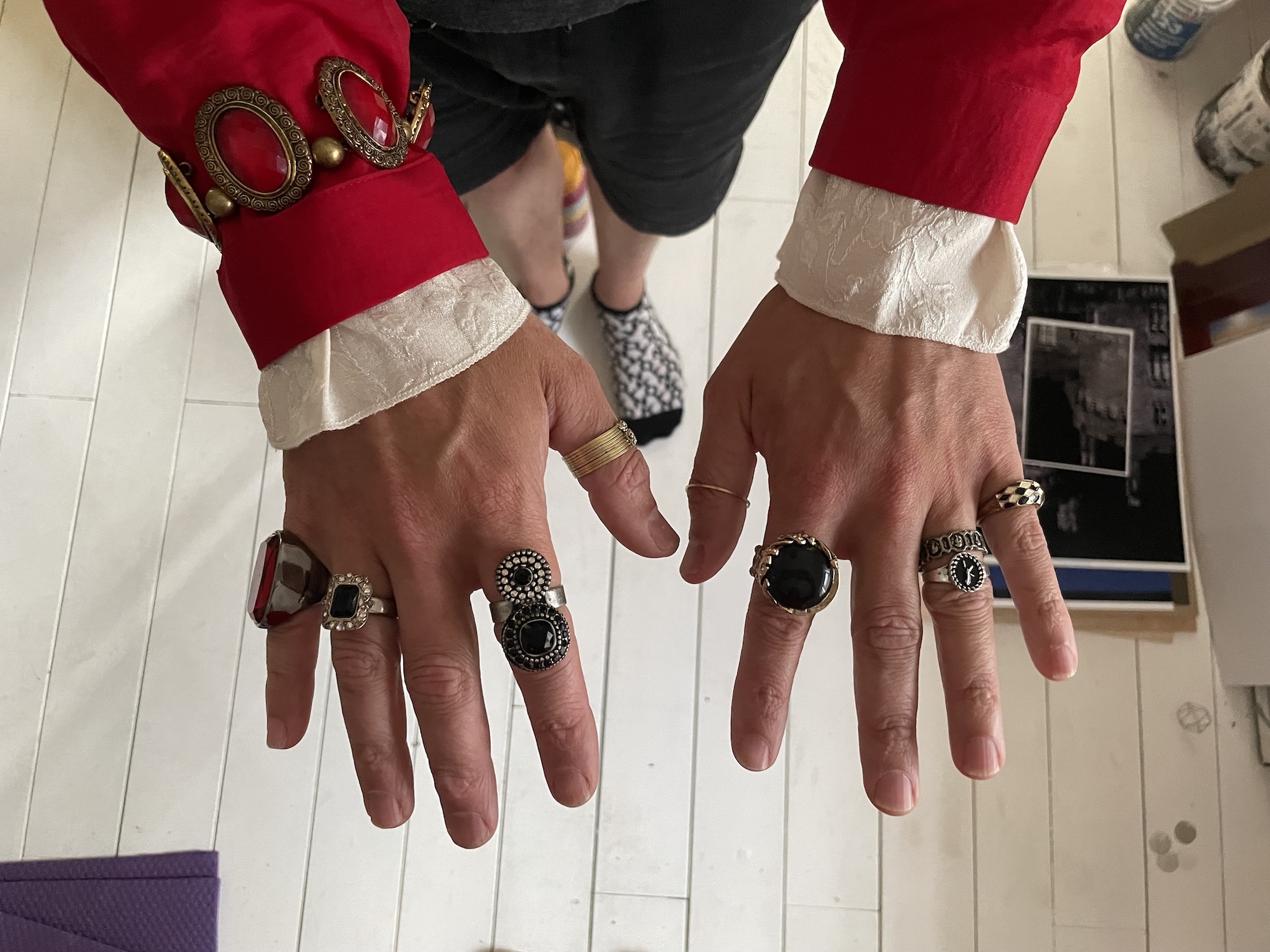 The bling of my court jester slash medieval magician type character.
As is often the case with these weird projects, I needed to come up with some creative technical solutions for how to actually film the thing. To avoid having a printed template under the jigsaw (as a reference for me to line up the pieces) I instead made a transparent guide image with numbered pieces, and used Dragonframe stop motion software to overlay that on the live image from the camera. This way, I could watch a monitor and place pieces in exactly the right place. Each physical piece had a number written on the back, so I just needed to follow the script. It took a lot of practice and many takes!
Screen-printing and Black 2.0
“Why, pray tell” I hear you cry, did you need screen-printing in all this? It turned out to be the ideal way to create A1-sized template of the castle outline, which I had also used for 2023’s project. Screen-printing through an extra-fine screen let me print black on matte black - so the printed lines didn’t show up in the footage, and green-on-green so both background and guidelines keyed out. Finally, for the jigsaw, the matte black card stock I was using for the background wasn’t black enough - and was reflecting some light from my lighting setup. Black 2.0 to the rescue - check out the image below - Black 2.0 (centre rectangular area) with the unpainted ‘black’ card stock visible in the perimeter.

JACK PHELAN - VIDEO ARTIST, DESIGNER, DIRECTOR WICKLOW, IRELAND.